Quaker Migrations, Quaker Records
& American Quaker Genealogy



Quaker Migrations, Quaker Records
& American Quaker Genealogy



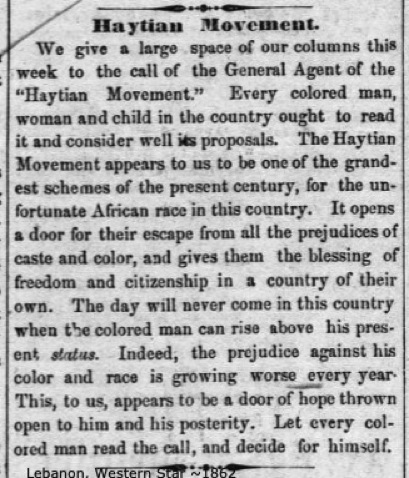
The Society of Friends were not alone in opposing slavery and worked with others for abolition. Most, but not all Quakers opposed slavery in the United States until the time of the American Revolution, at which time owners of slaves were “Disowned” by the Society.
Abolitionists were persecuted, especially in the South, and when slavery was prohibited by the Northwest Ordinance of 1787, Southwestern Ohio became a destination for early Quaker migrants into the Northwest Territory. Hence, in the early 19th century Quakers represented the dominant rural population in Southwestern Ohio.
Slavery had been largely ended in England early in the 1700s (but, not in the colonies until it was banned in 1887), and was a major issue of contention at the American Constitutional Convention. Months before the Constitution was created and one year before it was ratified, the Northwest Ordinance was passed prohibiting slavery in the Northwest Territories and establishing the Ohio River as the border between free and slave states. The tide against slavery in the United States was turning.

ANTI-SLAVERY SENTIMENT
In 1803, Zachariah Dix delivered a memorable sermon at the Bush River Monthly Meeting
(Newberry, NC) urging Friends there to leave for the free territory north of the Ohio River:
O Bush River! Purge thyself. Young men, young women, to you I appeal. The great northwest
territory lies over the mountains beyond the Ohio River. It is a wild forest. It is a wilderness.
From the wigwams of the savage the smoke still ascends through he boughs of the trees, but
it is a fertile land. It is a land forever dedicated to human freedom. There you can make
productive fields. There you can make friends with the Red Man. To you I appeal, flee to
that land. Shake the dust of human bondage from your feet for your own sake and for the
sake of your children’s children. This system of human slavery will fall. The cup of its
iniquity is well-nigh filled. Go to the Northwest Territory! Look not behind you into this
Sodom of human slavery, for the fires of Heaven shall descend upon it and the wrath of the
Almighty shall consume it. O Bush River, thy beauty has faded away! Thy light has gone
out, and in a few years this Meeting house shall be naught but the home of the bats and the
owls . . .

By 1735, the Eastern Colonies were becoming crowded, farmland was scarce. Before the Northwest Territory was open to settlement, great migrations began down the Shenandoah Valley on the Great Valley Road into the Tennessee Valley, Western Virginia and North Carolina (the Piedmont) and to the terminus in of the Great Valley Road in Augusta, GA on the Savannah River. See The Way We Lived in North Carolina.

The Kanawha Trace: Additional Migration Routes
In Our Quaker Ancestors, Ellen Berry wrote: In addition to the Kanawha Trace other frequently used routes include the Kentucky Road. Migrants crossed the Blue Ridge at Ward’s Gap, crossed the New River at Wythe Court House, Virginia, then through Abingdon, across the Cumberland Gap and up to Cincinnati.
Another route was by way of Poplar Camp and Flour Gap, then once again through Lexington to Cincinnati. A fourth route was known as the Magadee Route and came over the Virginia Turnpike which ran from Richmond to the Ohio River, at the mouth of the Kanawha River. There migrants either built rafts and floated down river, or continued across documented land routes, some as documented by Merle C. Rummel’s books, including Four Mile Community. Also, see Ohio Migration Trails by Maggie Stewart-Zimmerman.

QUAKER RECORDS
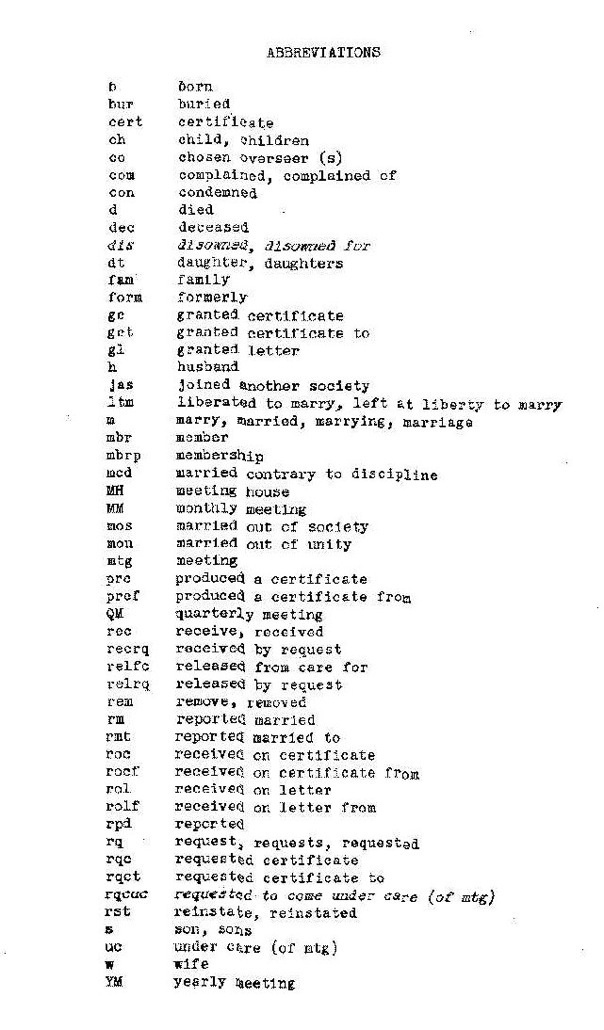
The Society of Friends (Quakers) maintained very good records from the time they arrived in America. Marriages, deaths, transfers to other meetings as well as disciplines were recorded as can be inferred from the list, below.
William Wade Hinshaw's Encyclopedia of American Quaker Genealogy is considered one of the best references of information for early American Quaker genealogy. The encyclopedia consists of six volumes, each dealing with a different geographic region. The Index to Hinshaw’s Encyclopedia of American Quaker Genealogy is a good place to start one’s Quaker genealogical research.
The volumes are arranged by meeting (church), beginning with the oldest and ending with the youngest. Each meeting is introduced with a brief history that includes the names of the earliest members. Next is a section listing information from the meeting's birth and death records, arranged alphabetically by family name. Following that is an abstract of the minutes of the meeting, including marriages, new memberships, transfers of membership, disownments, and restorations to membership. Again the entries are arranged alphabetically by family, and the chronologically. Below are Hinshaw’s abbreviations (though others were in common usage in Quaker records.)


Karen Campbell was the Local History and Genealogy Librarian of Waynesville ‘s Mary L. Cook Public Library for eleven years. Her special interests are in mid-western Quaker history and genealogy. See, Southwest Ohio Genealogical & Historical Research

© 2011-2022